![AIM-logo-white.png]](https://support.theaiminstitute.com/hs-fs/hubfs/AIM-logo-white.png?height=40&name=AIM-logo-white.png)
If you're having difficulties getting enough customers to agree to Blueprinting interviews, these 4 strategies can help:
-
Conduct fewer Discovery interviews
-
Enlist the right "askers"
-
Tailor your "ask" to the market type
- Seek alternative insights
Let's take a look at each strategy...
1. CONDUCT FEWER DISCOVERY INTERVIEWS
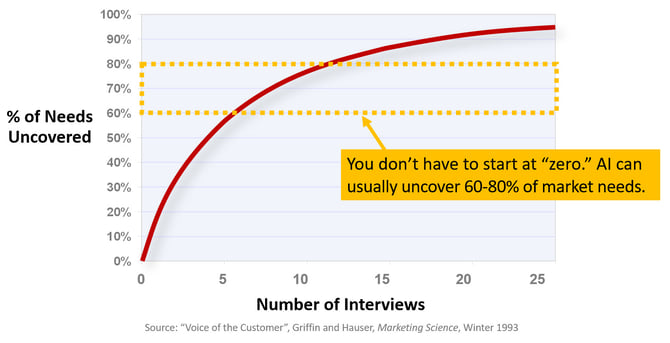
The main reason you conduct Discovery interviews is to adequately diverge to avoid "errors of omission." That is, you don't want to overlook an important customer outcome when its time to converge on customers' most desired outcomes via Preference interviews.
So you can stop when your Discovery interviews render mostly "echoes" of past interviews. (There are two exceptions: 1) You want to engage more key customers in the process, or 2) you want your teammates to have more interviewing practice.)
If you conduct interviews with AI first, you'll likely conduct about half as many Discovery interviews... perhaps 3-to-5 instead of 6-to-10. See Using AI to Prep for Discovery. Also, you'll find that Blueprinting Rapid Research tools help you gather excellent industry background, which can also reduce the number of Discovery interviews needed. (You can access Rapid Research at www.BlueprintingCenter.com.)
2. ENLIST THE RIGHT "ASKERS"
The likelihood the customer will agree to an interview goes WAY up when the "asker" and customer contact already have a strong relationship. It's simply hard to say "no" to someone you often work with. In many B2B companies, this "asker" is your salesperson that calls on the customer.
But some salespeople are resistant, for several reasons:
-
They're being rewarded for hitting sales quotas this year, not developing new products.
-
They don't understand these interviews well enough to portray benefits to the customer.
-
They see this as a distraction. If they're going to ask for something... it's the sale!
Here are some approaches you can take to mitigate these issues:
-
Ensure your sales leaders are sending strong signals that these interviews are important.
-
Reward them for setting up interviews in their sales incentive plan. This helps turn your "sales force" into a "learning force" as well.
-
Ask sales colleagues to learn more at www.BlueprintingForSales.com. To increase the likelihood they take time to read this, schedule a call to "see if they have any questions."
-
Conduct VOB (Voice of the Business) interviews with them before VOC. When salespeople play the role of the "customer" they see why customers appreciate these interviews.
-
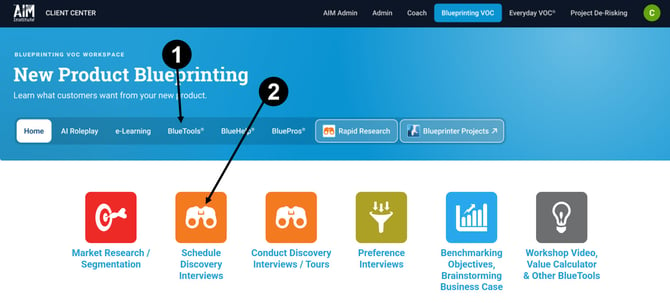
Arm your salespeople with the right tools. Go to www.BlueprintingCenter.com > BlueTools > Schedule Discovery Interviews to download and send them 1) Discovery Interview Agenda Template (after you customize it), 2) Script for Requestion Discovery Interviews. See more Tools for Setting Up Interviews.
3. TAILOR YOUR "ASK" TO THE MARKET TYPE
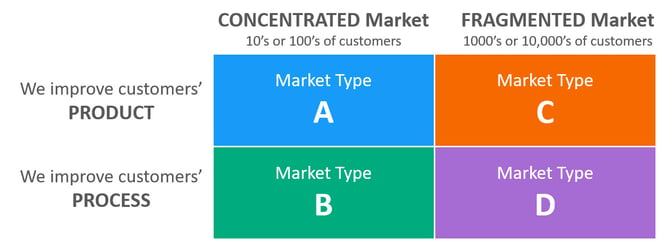
How do you make your request for an interview as appealing as possible? That depends on the type of B2B market you serve. See which of these 4 B2B market types best describes yours. Then check out the strategies below, with special attention to those matching your market type.
-
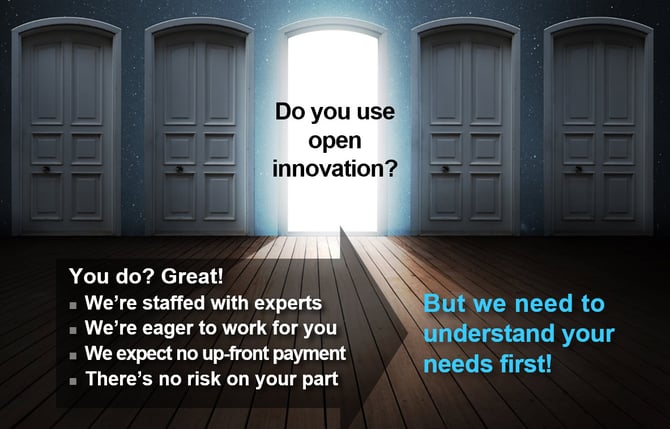
Do you use Open Innovation? (for Type A or B): Many large companies pride themselves on "open innovation"... their ability to seek innovation from outside. Let them know you're a great source of open innovation... but first you need to understand their needs.
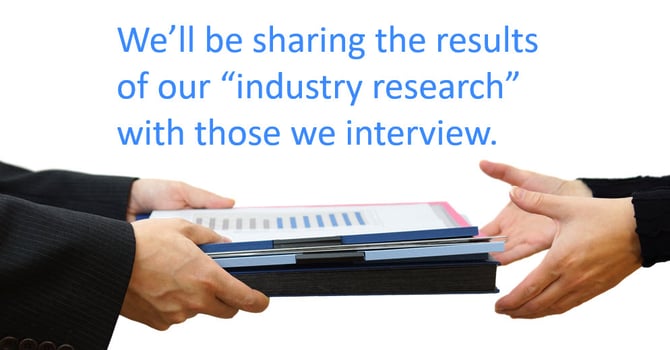
- Share your "industry research" (for Type A or B): Let prospects know you'll be conducting industry research and will share the results with those you interview. It's up to you how much you share: For more on this, watch the 2-minute video, Persuade Customers to be Interviewed. See a sample "Market Insights" report at www.BlueprintingCenter.com > BlueTools > Schedule Discovery Interviews > Sample Market Insights Report. Also, when its time for Preference interviews, let them know you'll share your "preliminary industry research." For more on this, see Scheduling Preference Interviews.
- Share past successes (for Type A or B): Share brief examples of how your company has brought innovative offerings to other markets... and that you'd like to do the same for this customer's industry. If you don't have such examples, explain that you've launched failed products because you didn't understand customer needs... and that you'd like their help in correcting this. (They're quite likely to appreciate your humility and may even identify with this problem.)
- Offer incentives (for Type C or D): Most large companies have policies preventing employees from accepting incentives. But this approach works well with tradespeople, craftsmen, nurses, etc. You can often invite customers from different businesses (hospitals, plumbing services, etc.) who are not in fierce competition to be interviewed together at a local hotel. Bring in great food, offer door prizes, gifts and/or gift cards.

- Trade shows (for Type C or D, sometimes A & B): Secure a hospitality suite or set up a conference room in your booth... and invite those tired aisle-walkers to join you for an interview. Lavish them with great food and gifts. For more, see Use Trade shows for interviews.
- Use Preference surveys (for Type C or D): When its time for Preference interviews, those with many customers can employ Preference surveys. It's often wise to start with some Preference interviews so you can ask follow-up questions and revise your outcome statements if they were unclear to customers. You'll likely need to offer an incentive to get a decent response rate. For more, see Conduct Preference surveys.
4. SEEK ALTERNATIVE INSIGHTS
Even with the above strategies, you may struggle to get enough interviews. This is particularly true if you have weak customer relations or are exploring a market where customers don't know you.
-
Use industry expert network. This is the most popular alternative. If you already subscribe to GLG, AlphaSights, Guidepoint or similar, use their services to schedule interviews. The AIM Institute has partnered with Maven Research to make their one-million-plus experts available via BluePros at attractive costs.
- Ask AI for consultant "connectors." Ask AI to find consultants that are already well-placed in the target industry... so they can introduce you to their contacts and/or schedule interviews. Try the following AI prompt:
- I need to recruit customer interview participants from the [target industry]. Rather than identifying potential interviewees, identify specific people and organizations that have extensive professional networks and could introduce me to knowledgeable customers. Prioritize independent consultants, consulting firms, retired executives who now consult, industry association leaders, conference organizers, technical trainers, and editors of industry publications. Favor individuals who actively work with multiple companies across the industry over experts whose careers have been spent primarily within a single organization. For each recommendation, provide the person's name, organization, current role, why they are likely to have a strong industry network, the types of people they probably know, a website or LinkedIn profile, and a 1–5 Connector Strength rating indicating their likely ability to recruit or introduce customer interview participants.
- Advisory Council: For existing markets, consider establishing an "Advisory Council." This council will include some of your most important customers that meet with you on a regular basis (perhaps quarterly). Be creative in making this attractive to them. As part of your advisory council, they'll likely be willing to be interviewed either separately (if they compete vigorously with each other) or as a group.
- Ask MAC: In your Blueprinting Center, under "Rapid Research," you'll find MAC, the Market Application Consultant. If you enter your target application in the "Application First" mode, MAC will deliver a list of customer problems, score them for you, and allow you to "dive deeper" on any of them. This isn't a good substitute for customer interviews on major projects, but for small, incremental product development, it's quite effective.